
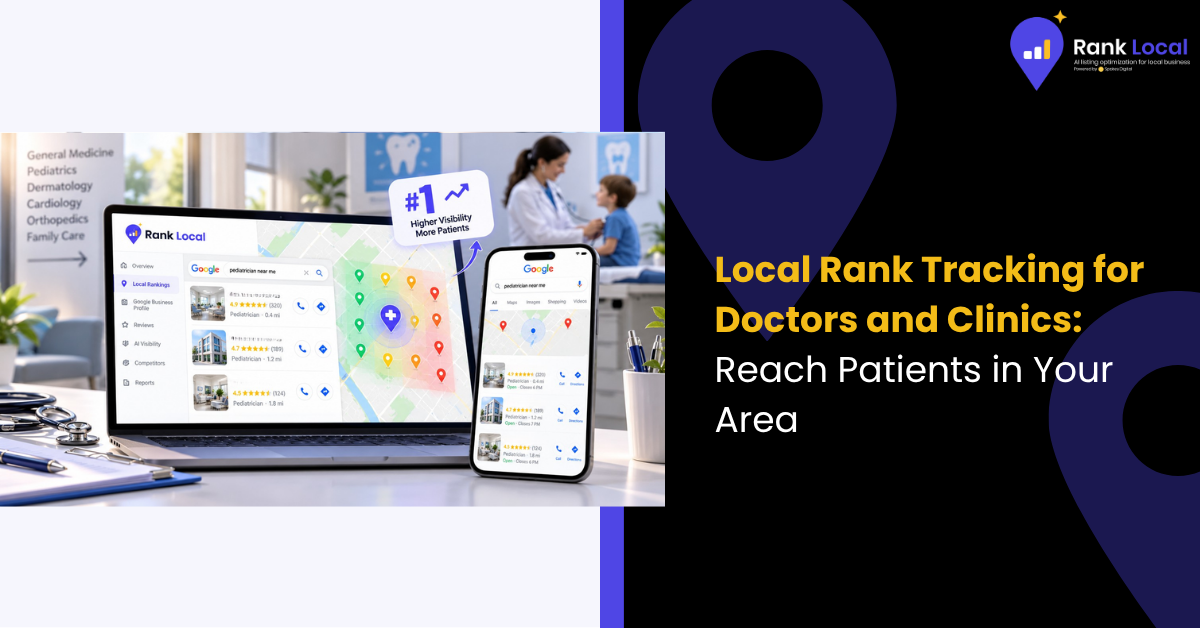
When a patient wakes up with sudden joint pain, a persistent cough, or a child running a high fever, they rarely flip through a phone book anymore. They grab their smartphone, open Google, and type phrases like "pediatrician near me", "best cardiologist in [City]", or "dermatologist open Saturday morning".
In under sixty seconds, they scan the map, glance at star ratings, read a few reviews, and tap to call or book an appointment.
If your medical practice or clinic isn't sitting at the very top of those local search results, you aren't just losing clicks, you're losing patients to competing practices down the street. For doctors, pediatricians, dentists, and specialized medical clinics, local visibility is the lifeblood of a steady patient roster. Yet many healthcare practices fly blind when it comes to tracking where they actually rank.
Here is a clear look at why standard SEO metrics fall short for healthcare providers, how local rank tracking works, and how your clinic can dominate local search to reach more patients in your community.
Why Traditional SEO Metrics Fail Medical Practices
For years, healthcare marketers relied on broad national SEO metrics. They tracked keywords like "heart doctor" or "skin specialist" across the entire country and celebrated when web traffic ticked upward. For a local clinic, that data is practically useless.
A patient in downtown Chicago searching for an orthopedic surgeon isn't looking for a clinic three hours away in Springfield. Healthcare is intensely localized. Patients want care that is geographically convenient, accessible by public transit or car, and plugged into their insurance network.
Furthermore, Google's local search algorithm evaluates three core pillars:
- Relevance: How well your business profile and website match what the patient typed.
- Distance: How close your clinic is to the physical location of the person searching.
- Prominence: How well-known your practice is online, driven by review volume, ratings, citations, and digital authority.
Because search engines personalize results based on the exact neighborhood, or even street corner, from which a query is made, your rank changes depending on where the patient is standing. If you check your ranking from your home office across town, you are seeing a skewed version of reality. To capture real patients, you need to track your visibility across your entire actual service area.
The Hidden Flaw of "Average" Rankings
Imagine checking your local ranking for "family practice clinic" and seeing that you rank #4. That sounds decent on paper. In reality, a single average ranking hides critical details.
Local map results operate on a hyper-local grid. You might rank #2 right outside your front door, but drop to #14 just two miles north because a competing clinic dominates that specific neighborhood.
This is where geo-grid local rank tracking comes in. Instead of testing a keyword from one static location, a geo-grid tracker overlays a virtual map over your city, say, a 5x5 or 7x7 grid of tracking points spanning your entire service radius:
- Point 1 (North): ranked #2
- Point 2 (Center — your clinic): ranked #1 — the spot where you usually check
- Point 3 (South): ranked #12 — a hidden blind spot
This reveals your true visibility:
- Where are you winning the top map spots?
- Where are you falling into a dead zone where competitors outrank you?
- Which neighborhoods require targeted optimization, review generation, or localized content to capture market share?
By visualizing your rank as a live heatmap, practice managers and medical marketers can stop guessing and start fixing exact geographic blind spots.
Core Strategies to Improve Your Clinic's Local Rank
Tracking your position is only step one. Once you know where your clinic stands across your local market, you can systematically optimize the signals search engines use to rank medical practices.
1. Optimize Your Google Business Profile
Your business profile is often the first touchpoint a patient has with your practice. It needs to be complete and accurate:
- Select Precise Categories: Ensure your primary category is exact (e.g., Pediatrician, Dermatology Clinic, Dental Clinic), and use secondary categories thoughtfully.
- Keep NAP Consistent: Your Name, Address, and Phone number (NAP) must be identical across your website, Google Business Profile, and healthcare directories.
- Detail Your Services: List every service you offer, from annual physicals to specialized diagnostics. Highlight accessibility features, languages spoken, and insurance accepted.
2. Build an Ethical, Steady Review Engine
Patients trust peer recommendations above all else. Review volume, rating frequency, and patient feedback heavily influence your local prominence.
- Make it seamless for happy patients to leave feedback via simple follow-up messages or QR codes at the front desk.
- Never buy or fake reviews; search filters actively remove artificial spikes, which can harm profile visibility.
- Respond to reviews professionally and promptly while strictly maintaining patient privacy.
3. Create Hyper-Local Content and Service Pages
If your clinic serves multiple neighborhoods or suburbs, don't rely solely on a generic homepage. Build optimized service pages that address local health needs, parking instructions, nearby landmarks, and specific treatments. When search engines see clear context connecting your practice to specific geographic communities, your local authority grows.
Take Control of Your Local Medical Search Visibility
Patients are searching for the healthcare providers they need right now. If your clinic is buried on page two or hidden outside your immediate zip code, those patients are walking straight into competing practices.
By shifting away from vanity metrics and implementing rigorous geo-grid rank tracking, accurate local SEO audits, and proactive reputation management, you can turn online searches into booked appointments, phone calls, and walk-in visits.
Track your true local footprint, close your visibility gaps, and make your clinic the easiest choice for patients in your area.